The story below can be viewed here, though I copied and pasted for your convenience. Anyone holding in Daf Yomi, I am pretty sure someone can keep the watch, as it should have a "din" of "zuto shel yam", unless I'm missing something. A modern day "Yosef mokir Shabbos"!!!
ELE‘ELE — With tennis shoes on, wallet in pocket and a bamboo stick in hand, Kaua‘i resident Curt Carish on Wednesday may have written himself into the most eccentric fisherman’s history book.To catch a fish with such simple gear would be an interesting tale in itself. But after Carish hauled in a nenue, the 10-inch fish coughed up a gold watch.“I was just sitting on a picnic table looking out into the ocean of Port Allen beach when I saw a nice-size fish awkwardly swimming close to shore,” Carish said. “So my friend Allen Hall gave me a bamboo stick and said, ‘Go get ‘em.’”Carish jumped into the waist-high water and struck the nenue a few times with the dull stick until the fish went limp.He said its stomach was abnormally large but he just threw the fish in the cooler along with his frozen chicken that he was going to barbecue that night.Tanley, a good friend of Carish, opened the cooler minutes later to discover a gold watch laying inches from the nenue’s mouth.“And the funniest thing is that the watch was on time and still ticking,” Carish said.Carish, who often hangs out at the private Port Allen Club with many other members, said in all of his 30 years on Kaua‘i he has never encountered anything this bizarre.
Monday, June 08, 2009


Monday, March 23, 2009
New York - Swedish Study Finds Fish Diet Boosts Intelligence Scores

The article was taken from here, though despite finding several news sources citing it from "DPA" I could not locate a DPA. Maybe I need to eat more fish...
New York - A regular intake of fish appears to boost intelligence scores in teenagers, according to a new Swedish study. The research suggested that 15-year-old males, who ate fish at least once a week, had "higher cognitive skills at the age of 18 than those who ate it less frequently."
The fish diet appeared to "increase combined, verbal and visuospatial intelligence scores by an average of 6 per cent."
Eating fish more than once a week almost doubled the score, according to the study published in the March issue of Acta Paediatrica said.
The researchers used responses from 3,972 males in the survey with cognitive scores registered in their Swedish military conscription records three years later.
"We found a clear link between frequent fish consumption and higher scores when the teenagers ate fish at least once a week," said Professor Kjell Toren of the Sahlgrenska Academy at the University of Gothenburg, western Sweden.
The fish diet appeared to "increase combined, verbal and visuospatial intelligence scores by an average of 6 per cent."
Eating fish more than once a week almost doubled the score, according to the study published in the March issue of Acta Paediatrica said.
The researchers used responses from 3,972 males in the survey with cognitive scores registered in their Swedish military conscription records three years later.
"We found a clear link between frequent fish consumption and higher scores when the teenagers ate fish at least once a week," said Professor Kjell Toren of the Sahlgrenska Academy at the University of Gothenburg, western Sweden.
Toren said the findings were "significant" since the research was conducted between 15 and 18 years of age "when educational achievements can help to shape the rest of a young man's life."
The researchers said they did not know what mechanism was linked to fish consumption and improved cognitive performance.
One theory was the benefits were linked to long-chain polyunsaturated fatty acids found in fish.
The leading author of the study, Dr Maria Aberg from the Centre for Brain Repair and Rehabilitation at the University of Gothenburg, said the team had considered other factors including ethnicity, where the teenagers lived, what level of education their parents had achieved, how often the teenagers exercised, their well-being and weight.
"Having looked very carefully at the wide range of variables explored by this study it was very clear that there was a significant association between regular fish consumption at 15 and improved cognitive performance at 18," Aberg said.
The researchers are now set to investigate whether the results were affected by the kind of fish eaten.
The researchers said they did not know what mechanism was linked to fish consumption and improved cognitive performance.
One theory was the benefits were linked to long-chain polyunsaturated fatty acids found in fish.
The leading author of the study, Dr Maria Aberg from the Centre for Brain Repair and Rehabilitation at the University of Gothenburg, said the team had considered other factors including ethnicity, where the teenagers lived, what level of education their parents had achieved, how often the teenagers exercised, their well-being and weight.
"Having looked very carefully at the wide range of variables explored by this study it was very clear that there was a significant association between regular fish consumption at 15 and improved cognitive performance at 18," Aberg said.
The researchers are now set to investigate whether the results were affected by the kind of fish eaten.
Monday, March 16, 2009
Rabbi Chaim Goldberg presenting at Lander College for Men


 UPDATE:
Around 30 students attended our Lander College excursion, where we talked about tilapia, trout, basa vs flounder, and salmon. A good time was had by all, especially me!!!
You can hear it by following the link here!

Lander College for Men 75-31 150th Street Kew Gardens Hills, NY Tuesday, March 17th from 5-6pm
THE KASHRUS OF FISH IN THEORY AND PRACTICE
A DEMONSTRATION
Given by
Rabbi Chaim Goldberg, Shlita
OU Fish Rabbinic Coordinator
Come one, come all!!!
Monday, February 02, 2009
Rabbi Goldberg Hits Boston!!!
UPDATE: YOU CAN WATCH THE VIDEO OF THIS AMAZING PERFORMANCE BY CLICKING HERE!!!
Many of my hardcore fans are already familiar with this appearance, but with my limited web skills (and lots of work going on) I finally got around to up loading this badboy. Hope it works this time!!
Many of my hardcore fans are already familiar with this appearance, but with my limited web skills (and lots of work going on) I finally got around to up loading this badboy. Hope it works this time!!
Wednesday, September 24, 2008

Thursday, July 31, 2008
Global Warming's Fish-Gender Effect

A small increase in water temperature among sensitive fish like the South American pejerrey can result in a population that is 98% male
Cousseau, B. and Perrotta, R.G. / Fishbase.org
Cousseau, B. and Perrotta, R.G. / Fishbase.org
(See original article at www.time.com)
Once scientists began studying the impact of global warming on everything from tourism to asthma, it was only a matter of time before they got around to sex. Now two biologists at Spain's Higher Council for Scientific Research (CSIC) have done just that, at least when it comes to fish.
You may have missed it in biology class, but in some finned species, like the Atlantic silverside — as well as in many reptiles — sex is determined not by genetics but by temperature: the undifferentiated embryo develops testes or ovaries on the basis of whichever option conveys evolutionary advantages for that particular environment. Now, in a study published in the July 30 edition of the scientific journal Public Library of Science, Natalia Ospina-Alvarez and Francesc Piferrer have gone a little further in explaining how that mechanism works. In laboratory tests, they have demonstrated that higher water temperatures result in more male fish.
"We found that in fish that do have temperature-dependent sex determination [TSD], a rise in water temperature of just 1.5 degrees Celsius can change the male-to-female ratio from 1:1 to 3:1," says Piferrer, the study's co-author. In especially sensitive fish, a greater increase can throw the balance even more out of whack. Ospina-Alvarez and Piferrer have found that in the South American pejerrey, for example, an increase of 4 degrees Celsius can result in a population that is 98% male.
What makes these findings especially troubling, of course, is that the International Panel on Climate Change (IPCC) predicts that ocean-water temperatures are likely to rise by 1.5 degrees over the course of this century — and they may even go up a few degrees more. "If climate change really does result in a rise of 4 degrees, which is the maximum the IPCC predicts, and if species can't adapt in time or migrate, then in the most sensitive cases of TSD, we're looking at extinction," says Piferrer.
Most research into fish sex determination has been done in the lab (for obvious reasons), but the pejerrey is one of the few species that scientists have been able to study in the field. And those studies have revealed that already, its proportion of males to females is skewed. "It could be because of chemical pollution or it could be because of climate change. We don't know," cautions Piferrer. "But the field data matches our predictions."
At this stage, it is hard to tell what these results bode for already declining fish populations around the world. Of the estimated 33,000 piscatorial species, only 5,000 have had their sex-determination mechanism affirmed. But the study by the two CSIC scientists also suggests that the percentage of TSD fish is lower than previously believed. In tests of 59 species believed to be reproductively sensitive to temperature, only 40 proved to be true TSDs.
That would be good news in this grim era of climate change if it weren't for one factor: even genotypic sex determination can be affected by anomalous conditions, including anomalous temperature. "Basically, if you freeze it or cook it enough," says Piferrer, "you can get whatever sex you want."
Monday, July 21, 2008
Fish pedicures: Carp rid human feet of scaly skin

See the AP story here.
By MATTHEW BARAKAT Associated Press Writer
ALEXANDRIA, Va. (AP) -- Ready for the latest in spa pampering? Prepare to dunk your tootsies in a tank of water and let tiny carp nibble away.
Fish pedicures are creating something of a splash in the D.C. area, where a northern Virginia spa has been offering them for the past four months. John Ho, who runs the Yvonne Hair and Nails salon with his wife, Yvonne Le, said 5,000 people have taken the plunge so far.
"This is a good treatment for everyone who likes to have nice feet," Ho said.
He said he wanted to come up with something unique while finding a replacement for pedicures that use razors to scrape off dead skin. The razors have fallen out of favor with state regulators because of concerns about whether they're sanitary.
Ho was skeptical at first about the fish, which are called garra rufa but typically known as doctor fish. They were first used in Turkey and have become popular in some Asian countries.
But Ho doubted they would thrive in the warm water needed for a comfortable footbath. And he didn't know if customers would like the idea.
"I know people were a little intimidated at first," Ho said. "But I just said, 'Let's give it a shot.' "
Customers were quickly hooked.
Tracy Roberts, 33, of Rockville, Md., heard about it on a local radio show. She said it was "the best pedicure I ever had" and has spread the word to friends and co-workers.
"I'd been an athlete all my life, so I've always had calluses on my feet. This was the first time somebody got rid of my calluses completely," she said.
First time customer KaNin Reese, 32, of Washington, described the tingling sensation created by the toothless fish: "It kind of feels like your foot's asleep," she said.
The fish don't do the job alone. After 15 to 30 minutes in the tank, customers get a standard pedicure, made easier by the soft skin the doctor fish leave behind.
Ho believes his is the only salon in the country to offer the treatment, which costs $35 for 15 minutes and $50 for 30 minutes. The spa has more than 1,000 fish, with about 100 in each individual pedicure tank at any given time.
Dennis Arnold, a podiatrist who four years ago established the International Pedicure Association, said he had never heard of the treatment and doubts it will become widespread.
"I think most people would be afraid of it," he said.
Customer Patsy Fisher, 42, of Crofton, Md., admitted she was nervous as she prepared for her first fish pedicure. But her apprehension dissolved into laughter after she put her feet in the tank and the fish swarmed to her toes.
"It's a little ticklish, actually," she said.
Ho said the hot water in which the fish thrive doesn't support much plant or aquatic life, so they learned to feed on whatever food sources were available - including dead, flaking skin. They leave live skin alone because, without teeth, they can't bite it off.
In addition to offering pedicures, Ho hopes to establish a network of Doctor Fish Massage franchises and is evaluating a full-body fish treatment that, among other things, could treat psoriasis and other skin ailments.
Ho spent a year and about $40,000 getting the pedicures up and running, with a few hiccups along the way.
State regulations make no provision for regulating fish pedicures. But the county health department - which does regulate pools - required the salon to switch from a shallow, tiled communal pool that served as many as eight people to individual tanks in which the water is changed for each customer.
The communal pool also presented its own problem: At times the fish would flock to the feet of an individual with a surplus of dead skin, leaving others with a dearth of fish.
"It would sometimes be embarrassing for them but it was also really hilarious," Ho said.
[ed. - Ewww.....]
Tuesday, June 03, 2008
Rabbi Chaim Goldberg's Fish DVD Released To the Public!!

NOTHING FISHY HERE! OU RELEASES ‘THE KOSHER FISH PRIMER’ DVD TO CLARIFY ISSUES OF WHAT MAKES THESE CREATURES KOSHER
View video here!!!
What makes a fish kosher, you say? Fins and scales. Everyone knows that. But very few people know that some scaled fish are as non-kosher as lobster! (See below to find out why.)
OU Kosher, as part of its ever-widening program of kashrut education, announced today the release of a new 30-minute DVD: “The Kosher Fish Primer – The Secrets Revealed,” featuring Rabbi Chaim Goldberg, an OU Kosher Rabbinic Coordinator who travels the world certifying fish as kosher. In his engaging manner, Rabbi Goldberg will delight audiences from young elementary school children to adults, as he explores the various issues the kosher consumer must consider when buying fish. Rabbi Goldberg doesn’t perform alone – fish are featured in the DVD as well. The recording is excellent for classroom and synagogue presentations.
Rabbi Goldberg, who received rabbinical ordination at Yeshivas Rabbeinu Chaim Berlin in Brooklyn, NY, has directed the Kosher Fish Desk at the OU for six years. Rabbi Goldberg's "fish-finding missions" for the OU have taken him to Alaska, Chile, British Columbia, Peru, Colombia, Trinidad and Iceland. When he closes his tackle box, Rabbi Goldberg returns to Brooklyn, where he resides with his wife and three children (but as he states, “no fish tank, yet”).
The DVD covers:
· The textbook definition of kosher fish;
· Pre-empting some potential misunderstandings about kosher fish (why one cannot rely on fish lists or other identifications of fish by common name);
· The potential Torah and rabbinic prohibitions relating to fish;
· An explanation of how to identify a kosher fish;
· A hands-on demonstration of how to identify a kosher fish yourself; and
· A quick tutorial on how to buy kosher fish from any fish store – even if it is not kosher certified.
“The presentation is titled ‘The Kosher Fish Primer’ to indicate that we are in no way claiming to have covered every topic worth teaching about kosher fish, but rather as a thorough introduction to more advanced study, depending on the level of the students,” Rabbi Goldberg explained. “We hope that after viewing this DVD, the viewer will be a properly informed fish consumer, who will be able to buy fish wherever in the world one travels.”
The new DVD is the latest in a series of initiatives of OU Kosher’s educational outreach. This outreach includes programs such as “OU Kosher Coming,” which sends OU experts to schools, synagogues and campuses to share their knowledge of Jewish law and food technology; it features as well as the “Kosher Tidbits” web series, consisting of more than 100 short seminars on innumerable aspects of kashrut, and available on http://www.ouradio.org/. The “Kosher Kidz” video has been sent to yeshivot and day schools throughout North America to provide a basic understanding of what makes food kosher, with the production of kosher ice cream as the example.
Now, about that non-kosher fish with scales. Some fish have scales which cannot be removed from the fish without ripping the skin (like some sharks and eels). These fish are not kosher, as Rabbi Goldberg explains.
The video can be obtained from OU Kosher by contacting Rabbi Eliyahu Safran, OU Kosher Senior Rabbinic Coordinator and Vice President of Communications and Marketing, at safrane@ou.org.
http://www.ou.org/
http://www.oukosher.org/
Monday, April 28, 2008
Think before consuming...
 The view from the beach of Puerto Montt, Chile Jan 2006.
 We recently discussed the kashrus concerns of various salmon diseases (see post of March 28th entitled, "Does Illness Affect Kosher Status of Fish?" below). All kashrus aside, today I'm struck with thinking about the "morality" of the whole thing.
Don't get me wrong, I'm not advocating the end of farmed fish (we eat plenty of farmed salmon and tilapia at home, despite my misgivings about it). What I am saying is that all consumers (be they of food, natural resources, or even other people's time and money for that matter) have a certain responsibility to be aware of the other side of their consumption. Let's call this my thesis.
Today's story is from the Patagonia Times (a newpaper highlighting the area of Chile where salmon is farmed) regarding the move of salmon farms from "Region X" to "Region XII". The reasons for the move are clear - there isn't enough room in Region X, and there is need for disease free waters for farming.
After reading the story, you can get the sense of how much salmon farming may be effecting the environment, all in the name of consumption.
For those less familiar with Chile (I was lucky to be able to visit in Jan 2006, for business) the areas are not divided by states or counties so much as "Regions", starting from the north and running south. Most Chilean salmon (70% according to this article) are farmed in Region X, in and around Puerto Montt.
Consume as you wish. My suggestion, simply think before consuming...
Tuesday, April 01, 2008
Kosher Fish Video, starring Rabbi Chaim Goldberg in the works!!
UPDATE JUNE 3, 2008: THE KOSHER FISH DVD IS OFFICIALLY RELEASED. TO OBTAIN A COPY, E-MAIL SAFRANE@OU.ORG. SEE BLOG POST OF JUNE 3RD FOR FULL PRESS RELEASE.


Kosher Fish Destination enthusiasts, get in line. The much talked about video of your host, Rabbi Chaim Goldberg, will soon be available at http://www.oukosher.org/. The actual link directly to the video will be posted here when available, maybe even the video itself if I can figure out how to do it.
As reported in other places (meaning, had you asked me personally before today) , this video was made primarily as a classroom primer, aiming to help teachers explain kosher fish to classes outside of the Metro NY area, where I cannot travel with my piscine friends. However, adults will find it both entertaining, captivating, and worthy of nomination for a major award. At least my mom will thinnk so when she sees it. I hope...
Stay tuned!!!
Friday, March 28, 2008
Teach your Children How to Tell if a Fish is Kosher!!!

Folks, it is parshas Shemini. Yes, I know its Friday, but it is not too late!!
Here's the thing. Teachers tell students the signs of a kosher fish are fins and scales, which as my avid readers know is not accurate at all). The Torach says a kosher fish has "snapir v'kaskeses", which Ramban Vayika 11:9 explains are scales which can be removed by hand or with a knife without ripping skin.
How hard would it be to add this little addendum when telling you children (as young a 5!!) how to know what a kosher fish is?
For your younger yungins, I have a little song to use to help them rememeber (sung to the tune of "Twinkle twinkle little star":
Kaskeses is the way to know
If in my tummy this fish can go
If a scale comes out, and doesn't rip skin,
Look out tummy, its coming in!
But if a scale you cannot find
Your fish might be, a treife kind
Is this too hard for a small kid to learn? It is a Torah commandment to learn how to differentiate between kosher and non-kosher species, an integral part of our MESORAH, and best of all, it might even prevent you kid from buying a treif fish some day...
If you really need to, go here and learn more about the biology of the fish, or ask me to come over and help!
Does Illness Affect Kosher Status of Fish?

Sea lice from young wild salmon. Photo by Alexandra Morton
Question: Does illness affect kosher status of fish?
Answer: In short - absolutely not!
Illness does not affect kosher status of any fish, which is determined exclusively by the presence (or absense) of "kosher scales", namely scales which can be removed from the fish without ripping the skin.
The question came up because of a recent NY Times story here about Infectious Salmon Anemia (ISA) . While in animals and birds there IS a concern about disease, there is no such limitation found in salmon.
Fear not!
Now, for the long(er) version:
"The practice of aquaculture is not without negative impacts. The harmful consequences and risks associated with aquaculture can be broken down into the three subcategories below. They are: risks to the farmed fish themselves; risks to the surrounding environment and organisms; and risks to the human population. "
This quote is from: Duke University's Biology dept, whose cite can be found here. They know more about the effect on people than me, so read up!
To the best of my (little) knowledge, the diseased fish are not usually sold, and any fish whose disease would impact humans are not (spuuopsed to be) sold.
I do not see a practical issue for my subscribers.
Same thing for salmon lice (which some kosher agencies are crazy about). As I remember from a conversation I had with Avi Attias (co-owner of Banner Smoked Fish in Brooklyn, NY) any lice on the fish fall off after they are frozen, and are so huge and ugly that they would never wind up in the food supply.
In long: fear not!
Monday, December 11, 2006
Species Focus: John Dory
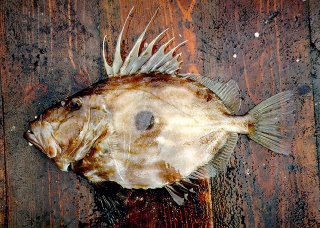
In case you are wondering why we started with John Dory, the answer is: why not!
I have not personally even eaten John Dory (also known as St. Peter's Fish) which is one of those "exotic" fish that people inquire as to whether or not it is kosher because it seems exciting. It comes from Australia, which means two things to most kosher consumers:
1. It is going to be expensive
2. It is likely to be skinned
For those of you not excluded because of #1, #2 is going to be an issue. The first rule in kosher fish is that it must either have skin on (so that you can check for kaskeses yourself) or have hashgacha.
Yes, from what we have seen John Dory (Zeus Faber) appears to be kosher. Its scales seems to be small and smoewhat embedded (referred to as scutes), though they are still kosher if they can be removed without ripping skin. Someone who has tried it themselves should kindly reply to this post and tell us about it.
Just to mention, talk about John Dory feeding on non-kosher species should not discourage you from buying it (for those familiar with the prohibition of eating something whose entire plumpness is derived from forbidden foods). We noted that it feeds on kosher species as well.
There was one place that had interesting recipes that looked possible for us non-professional type's, but it is likely to fit in any recipe for tilapia. For what is is worth, Fishbase.com notes that it can be, "steamed, fried, broiled, microwaved, and baked".
If you buy it whole, note that yield is rather low (about 30-35% of the whole fish can turn into edible dinner). For more details on the texture, taste, and nutritional values for John Dory, click here.
New Regular Feature on Kosher Fish Destination!!!

 We here at Kosher Fish Destination have heard you, and we intend on updating regularly with a "Species Focus" on particular species of kosher repute. Feel free to e-mail me with your suggestions and requests, as well as any other thoughts about Kosher Fish Destination (especially if you enjoy the site or benefit from it). We love hearing from you!!!
Wednesday, September 20, 2006
Truth about red salmon
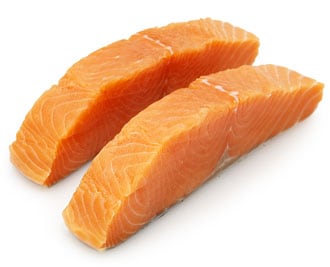
Last week's HaModia featured part 1 of an article written by Yissachar Brody and myself addressing objections raised by other kashrus organizations about the soundness of saying that any fish which looks like a salmon is a salmon. While I am reticent to accept the idea that all red-fleshed fish are kosher, I personally think it is correct to say that there is no fish which one can practically substitute for salmon. The unedited version of the article (part 2 included) will eventually appear at OU.org. A copy can be e-mailed to you upon request.
Wednesday, August 02, 2006
Rabbi Chaim Goldberg at Askmoses.com!!


Yes, my latest HaModia article appears ask an Askmoses question about how one can tell if a fish is kosher. Today Askmoses, tomorrow the world...
Friday, July 28, 2006
A hair-raising experience: Inviting Rabbi Goldberg to speak about fish?

If anyone is interested in inviting me to speak on the topic of kosher fish (and to demonstrate how to check a fish for kosher simanim), or on any other topic on kashrus, drop me an e-mail. There is no charge for the service, though travel expenses are not necessarily included (hey, I can't exactly walk to Saskatchewan).
So far I've been invited to (all in Brooklyn, NY):
Stoliner High School
Nefesh Academy
Sinai Academy
Yeshiva/Kollel Ruach HaTorah
Evening Program at Agudath Yisroel Beis Binyomin
Mesivta Tifereth Jerusalem (MTJ)
Schools are obviously an option, though shuls and learning groups are great places to demonstrate on fish as well. The program is fun, entertaining and well received. Hope to see you!
Oh, bring clips for your yarmulkes. Or a really big hat...
Thursday, June 15, 2006
Rabbi Goldberg speaking live tonight!
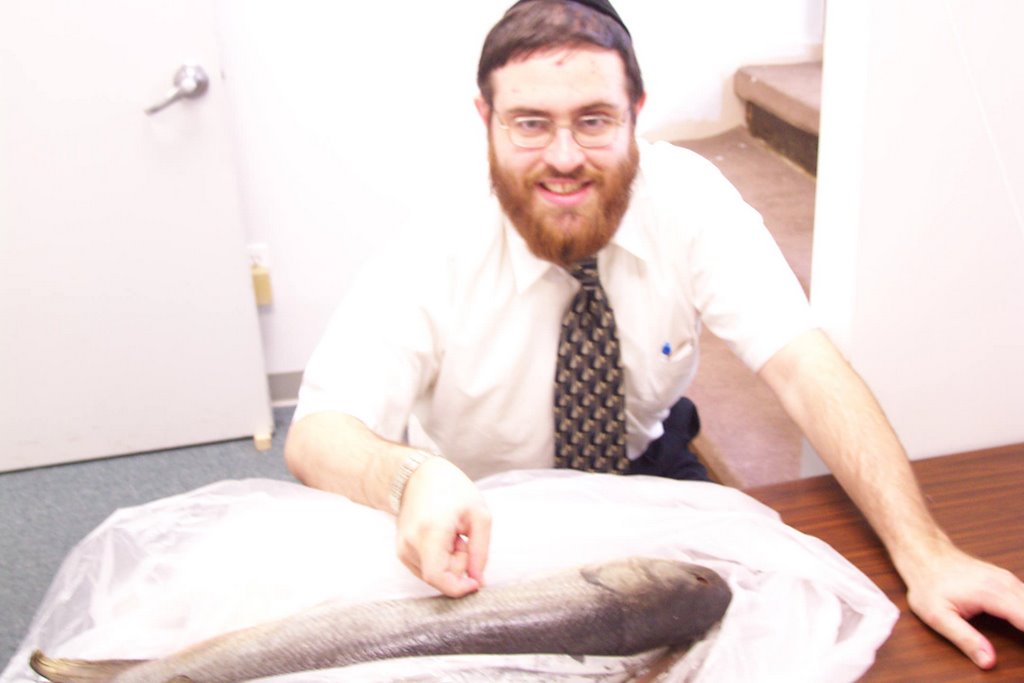
Reports of Rabbi Goldberg speaking tonight at Agudath Yisroel Beis Binyomin have been confirmed. That's right all my loyal fans (and you know who you are), are welcome to a public viewing of my speaking/demonstating abilities. The topic (of course) is kosher fish.
Come one, come all 9:30 Maariv, 9:50 Speech. Corner Nostrand and Ave L.
Tuesday, May 30, 2006
Live Fishcam Link!
Now you too can enjoy some quality time in front of a fishtank which you do not need to care for, thanks to "Jason's Fishtank", the only streaming "fishcam" that I could locate.
Extra credit for anyone that can identify if any of the fish are kosher (hint: note the fish by name, where discriptions of species are given).
Tuesday, May 23, 2006
An Analysis of Kaskeses Part 2
An Analysis of Kaskeses – past and present Rabbi C. Goldberg HaModia, May 17, 2006



In part one of this article, which appeared in the March 22nd edition of HaModia, we discussed what the requirements are for fish to be kosher (i.e. that the fish needs to have “kaskeses” and what is a “kaskeses”), as well as some of the common mistakes made in trying to determine which fish would qualify as kosher. In this article, we will discuss two practical methods to determine if a fish is kosher.
The easiest way to determine if a fish is kosher, is by manually checking the fish for scales[1]. Simply locate a scale on the side of the fish (preferably behind the gills, tail or fin – as mentioned by the Rama as a chumra to guarantee the scale did not fall off of another fish), grab it between your thumb and forefinger, and gently attempt to pull it out. One should note that scales are always attached to the fish on the side closer to the head. The reason is fairly obvious if you can imagine how a fish swims. If the scale would be attached to the skin at the side closest to the tail, the current would pull the scale away from the skin and would inevitably rip it off as the fish swims. Imagine an open umbrella in a brisk wind that is not pointed in the direction of the blowing wind. The umbrella would get caught in the wind and blow inside out. So too, the current would get caught under an inverted scale and rip it off, causing the fish to die due to infection.
After removing the scale, simply inspect the area where the scale came from and check if there is a rip in the skin. If the skin seems fairly undamaged, the fish is kosher. If the scale will not come out without the skin ripping, the scale is not a “kaskeses”. Generally speaking, it is fairly obvious if the skin ripped. As a practical way to get a sense of what skin normally looks like when a “kaskeses” is removed (and the skin does not rip) one could inspect the scaleless skin of fish which one knows to be kosher.
As long as a fish has “kaskeses” at some point in it’s lifecycle it is permitted and there is no requirement of “mesorah” (i.e. a tradition that identifies a particular fish as a kosher species). Fish that lose their scales often have a single scale in the three areas mentioned earlier (behind the gills, tail and fin), though even without a scale present one could still recognize a kosher species of fish based on its skin. The Darchei Teshuva describes the possibility of determining the kosher status of a scaleless fish based on “mesorah”. The “mesorah method” is derived from an idea mentioned in our previous article article, namely that the Gemara tells us that a fish that has not yet grown “kaskeses” or lost its “kaskeskes” is still a kosher specie. One should ask, even if theoretically true, how could one practically determine that the fish is kosher if there are no “kaskeses” on it now? The answer, says the Darchei Teshuva, is that one can recognize the specie based on its skin. There is no mention of someone with a “tvias ayin” on the flesh of a fish, which must be regarded as “kirvei dagim”[2] and is forbidden.
Therefore, one may bring a fish whose “kaskeses” fell off or did not yet grow “kaskeses” but whose skin is still attached to someone familiar with the specific fish to determine if this is a species that is subject to a mesorah of being a kosher fish. This “mesorah method” of determining kosher status is particularly useful when dealing with various types of mackerel. Mackerels tend to lose their scales when removed from the water, and the mesorah method can be used to permit the scaleless mackerel. Generally, this mesorah method does not apply to fish whose skin is removed.[3]
It is essential to note that the person ruling on the fish must be both “halachicly” reliable and familiar with the issue at hand (in our case, the specific type of fish). A typical worker at a fish store is not qualified to confirm the kosher status of the fish.[4]
Some have asked how big a piece of skin must be left on the fish for one to determine its status based on the “mesorah method”. Though I have not seen a specific size given, clearly the piece of skin must be big enough for someone to actually be able to say what species it is. A few weeks ago, I received an inquiry from a small hashgacha organization, that wanted to know how they could accept as kosher fish whose skin had been completely removed except for a small (scaleless) patch, when their mashgiach could not properly identify the fish. I answered that they could not. The only way to accept the fish is by having someone familiar with the specie accept the delivery, and a mashgiach who is not familiar with the specific fish is not qualified to accept such fish. Consider the following mashal (parable). Suppose a person, r”l, is blind. Halachicly, the person is “ne’eman” to testify in Beis Din. One would not, however, ask the person to confirm which of two identical pieces of meat has a hashgacha printed on the package. Here too, a person who does not have mesorah on the particular fish in question may not be relied upon to confirm the kosher status of the fish by a patch of skin. Such a person could only attempt to remove a scale from the fish, as described above.
Some hashgacha organizations allow for salmon to be accepted without skin at all. The justification behind this policy is that there are no known fish whose flesh resembles the red/pink of a salmon, making the flesh color a “siman muvhak” (an absolute indentifier of the fish, which would pre-empt the requirement of checking for scales). Again, this heter would only apply to a case where the mashgiach accepting the fish knows what a salmon is supposed to look like.
Many of us are “zoche” to live in areas where we don’t much think about which fish are kosher or not, as we could not imagine the local “heimish” supermarket selling a non-kosher species. Some of us live in parts of the world where kosher meat is difficult to acquire, and buying fish from the local store is the easiest way to properly feed our families. Though it may seem odd at first, people living neighborhoods which do not have kosher fish stores have at least one advantage over their brethren living in neighborhoods that do. They have the chance to teach themselves and their children how to determine if a fish is kosher, often having no other option. It would be unfortunate if those of us who can easily acquire a kosher fish would lose out on the opportunity to know how to be “mavchin bein hatamei u’bein hatahor”, to be able to distinguish between the pure and the impure.
Rabbi Goldberg has been working as a Rabbinic Coordinator in the Orthodox Union for four years, specializing in kosher fish. He has spoken at various school groups and professional conferences. If you would like to arrange for him to make a free kosher fish demonstration for your shul,school or learning group anywhere in the US or Canada, please feel free to contact the Orthodox Union at 212-613-8340.
[1] As discussed in the first part of this column, from the March 22 edition, there is no practical requirement of checking for fins.
[2] See Y.D. 83:7. This is the term given to skinless fish innards, which aren’t kosher unless prepared under hashgachah.
[3] Some species, however, can be identified as kosher even after the skin is removed. A common example of such fish is salmon.
[4] The rules of “mirsas” and “aman lo mareh umnaso” likely do not apply in the typical consumer situation, where the persons serving the consumer have neither fear of making a mistake, nor negative ramifications by implying that a specific fish is kosher. The FDA (see FDA Consumer Magazine September 1993) also recognizes the prevalence of misidentification of species in the fish industry. Therefore, one should not readily rely on a storekeeper to identify the species of fish.
Subscribe to:
Comments (Atom)